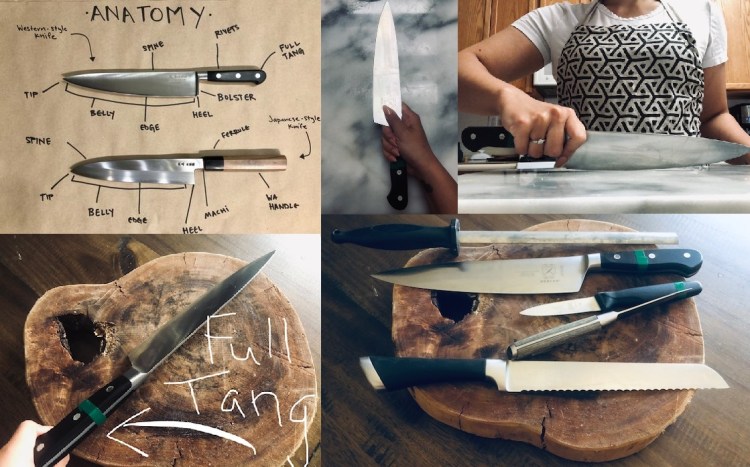
Ok, I need to preface by saying I am absolutely not a master of knife skills, in fact I have just enough knowledge to take care of my ladies, and most of the time not get cut by them (or at least not sever an appendage). However, seeing as a knife is your single most important tool in the kitchen, I feel obligated to share what little wisdom I have, and point you in the direction of where to get more learning. First up: anatomy of a knife, please reference the awesome photo I’m borrowing from Bernal Cutlery (definitely check them out for more detailed info on knives). Each area is pretty self-explanatory, you’re going to hold the knife by the handle, and cut with the edge (sharp bit). Going a little deeper into the skeleton of your knife you have what’s called the tang; this is the continuance of the knife into the handle. You pretty much either have a full tang, like my knife, or varying degrees of a partial tang. A full tang is when the metal of the blade extends through the entirety of the handle, and a partial tang is when it doesn’t, this can either mean that it stops halfway through the handle, or is a spindle (called rat tail) that is the length of the handle, but narrower. Most chefs prefer a full tang, as it offers the best handle reliability and control of the knife. Now that you know the parts of your knife, lets move on to how to handle her. As show in the pictures above, you’re going to want to choke up on the handle, and have your middle finger resting on the bolster with your pointer finger and thumb on either side of the blade for stability. This grip offers the most control, versus wrapping your entire hand around the handle. Now handle length and shape comes into play here with regard to comfort – how you grip your knife generally isn’t going to change from knife to knife, so when shopping you want to find a handle that sits easy in your grasp. For more info on knife handling: google any other chef that isn’t me, you’ll get better advice #honesty. So, you know the parts of your lady, you the know the basics of how to hold her, only thing left is how to care for her. Firstly, keep her sharp, nothing will ruin your day faster than a dull knife. Depending on the quality of your knife and the frequency of use, you generally only need to sharpen your knife 2-3 times a year, but you should hone it regularly. What’s the difference between honing and sharpening and you ask? Sharpening is grinding or shaving layers of metal away from the blade and making a new, sharp edge. This is done with a water stone or whetstone. Honing, on the other hand, is done with a sharpening steel, which is a quite confusing misnomer. Despite what it’s name suggests, a sharpening (honing) steel does not in fact sharpen your knife, but rather pushes the edge of the knife back to the center and straightens it. It corrects the edge without shaving off much, if any, of the blade’s material. If honed properly, the knife will seem sharper because the blade is now in the proper position. Lastly, keep your knife clean, and ALWAYS hand wash your knives. Knives are usually made with steel, and steel and water do not mix well; you’ll want to wash and thoroughly dry your knives after use to avoid patina and rust. I can’t stress enough that these are the basics when it comes to knives, but it should be enough to get you started and give you enough of a knowledge base to g
 Provisioned Kitchen